Exposing False Teachers/Preachers
. . . Beware of false prophets, which come to you in sheep’s clothing, but inwardly they are ravening wolves. Matthew 7:15
Spirit-Led or Purpose-Driven – Part 5
Spirit-Led or Purpose-Driven? Part 5
Spiritual Gifts and Community Service
By Berit Kjos – July 2004
“The Church of the 21st Century is reforming itself into a multi-faceted service operation.” Bob Buford, founder of Leadership Network and founding president of the Drucker Foundation for Nonprofit Management.[1]
“More and more social needs are being met by these private organizations rather than large government bureaucracies…. Peter Drucker has called this private sector of social services the fastest growing segment of economies around the world.”[2]
“[Rick] Warren says, ‘I read everything Peter Drucker writes…. Long before words like ’empowerment’ became popular, Peter was telling us that the secret of achieving results is to focus on your strengths, and the strengths of those you work with, rather than focusing on weaknesses.”[3]
“[God] said to me, ‘My grace is sufficient for you, for My strength is made perfect in weakness.'” 2 Corinthians 12:9
“God has a unique role for you to play in his family,” writes Pastor Warren. “This is called your ‘ministry,’ and God has gifted you for this assignment: ‘A spiritual gift is given to each of us as a means of helping the entire church.‘ [1 Co 12:7-8, NLT] Your local fellowship is the place God designed for you to discover, develop and use your gifts.” [4, page 134]
Yes, that’s partly true. God calls each of us to specific roles in the Church. In his letter to the church at Corinth, Paul wrote,
“Now concerning spiritual gifts, brethren, I do not want you to be ignorant…There are diversities of gifts, but the same Spirit. There are differences of ministries, but the same Lord. And there are diversities of activities, but it is the same God who works all in all. But the manifestation of the Spirit is given to each one for the profit of all: for to one is given the word of wisdom through the Spirit, to another the word of knowledge…. But one and the same Spirit works all these things, distributing to each one individually as He wills.” 1 Corinthians 12:4-11
Yet, His work through us isn’t limited to “the local fellowship.” God will use the gifts He gives us wherever He sends us. He will equip us for any assignment He gives us — when we hear and follow Him. “He who calls you is faithful, who also will do it.” [1 Thessalonians 5:24] While your service to Him may start at our local church, His true Church reaches around the world. Pastor Warren points that out in a later section of His book.
Today’s popular church surveys and “continual assessments” are misleading tools for discovering our spiritual gifts and place of ministry. Yet they — along with peer opinions and personal “experimentation” — are among the tools new members of Saddleback Church are encouraged to use to “discover,” record, and develop their spiritual gifts and potential for service. Though God doesn’t command us to “discover” our gifts, the man-made rules of the new church-growth hierarchy do.
So do powerful globalist leaders and management gurus. As Peter Drucker tells pastors,
“The pastor, as manager, has to identify their strengths and specialization, place them and equip them for service, and enable them to work in the harmonious and productive whole known as the body of Christ.”[5]
Peter Drucker’s vision of the global management structure can be divided into three sectors: (1) the government sector, (2) the private (business) sector, and (3) the social sector. In the last or “third sector,” the key provider of social services would be churches. That’s why his efforts in the last decades have focused on church management and the leadership training needed to train church members to serve their communities.
Bob Buford, the founding chairman of the secular Drucker Foundation for Nonprofit Management, also founded the “Christian” Leadership Network, which helps pastors and church leaders build “successful churches” based on Drucker’s management policies and communitarian philosophy. The Drucker-Buford success story now reaches around the world, and the main trophies of his organizational talents are the mega-churches in the United States.
So why is that a problem? When the world’s secular managers tutor church leaders in church management in order to equip the “social sector” to fulfill the government’s vision for social welfare, God’s ways and truths will be compromised. In partnerships between the governmental and social sector, the former (which sets the standards and helps fund the projects) will always rule. Notice the blend of truth and distortion in Pastor Warren’s next statement:
“When we use our gifts together, we all benefit. If others don’t use their gifts, you get cheated, and if you don’t use your gifts, they get cheated. This is why we’re commanded to discoverand develop our spiritual gifts. Have you ever taken the time to discover your spiritual gifts? An unopened gift is worthless.” [4, page 237] Emphasis added
In the well-defined purpose-centered atmosphere of the postmodern church, discovery and development depend more on human plans and management formulas than on faith in God and the silent work of the Holy Spirit. Perhaps that’s why Pastor Warren suggests,
“Begin by assessing your gifts and abilities. Take a long, honest look at what you are good at and what you’re not good at. Ask other people. Paul advised, ‘Try to have a sane estimate of your capabilities.’ [Romans 12:3b, The Message] Make a list. Ask other people for their candid opinion…. Spiritual gifts and natural abilities are always confirmed by others.” [4, page 250]
They are? What if your spiritual gift has nothing to do with your natural talents or personal preferences? What if God gave you gifts that would show His exceeding greatness, not yours? In stark contrast to Pastor Warren’s view of spiritual gifts, the apostle Paul said,
“I, brethren, when I came to you, did not come with excellence of speech or of wisdom declaring to you the testimony of God. For I determined not to know anything among you except Jesus Christ and Him crucified. I was with you in weakness, in fear, and in much trembling. And my speech and my preaching were not with persuasive words of human wisdom, but in demonstration of the Spirit and of power, that your faith should not be in the wisdom of men but in the power of God.” 1 Corinthians 2:1-5
Did you hear that? God uses weak but faithful believers who will demonstrate His power, not their own talents. In fact, our own talents are often the opposite of our spiritual gifts. History shows us how some of God’s most powerful messengers served in total weakness, all the more demonstrating the amazing power of the Holy Spirit. Now as then, many of His servants come to Him as quiet, shy introverts who would fear speaking their name in a group and would shudder at the improbable thought of ever speaking in front of a group.
That’s where I was years ago: shy, avoiding groups and dreading attention. But when I surrendered my life to my Lord Jesus Christ, He filled me with His Spirit and gave me the absolute assurance that His strength was sufficient in my overwhelming weaknesses.[6] Then, as I immersed myself in His Word — trusting His promises and seeking His will — I found that every time He gave me an impossible task, and I said yes (often after agonizing struggles and sleepless nights), He provided the love needed to overcome my fears, the words needed to counsel the needy, the courage to stand in front of a microphone, and the message needed to encourage His people. It was all by the wonderful, gracious gifts of my Lord and Shepherd! His life had filled this broken earthen vessel to overflowing!
I still don’t know what my permanent spiritual gift or gifts are. Different challenges in my life have called for different gifts. None, other than perhaps service, matched my natural inclinations. That’s why I chose to study nursing. But God had a different plan. He showed me that to use His gifts, I just needed to keep my heart and mind fixed on Him, not on myself — “looking unto Jesus, the author and finisher of our faith” (Hebrews 12:2). Then any assignment He would give me would be matched by the spiritual gift(s) and resources needed to triumph in Him.
Notice that Pastor Warren used a quote from The Message to validate his last point “Begin by assessing your gifts and abilities. Take a long, honest look at what you are good at and what you’re not good at.” But the corresponding verse [Romans 12:3] in any of the standard translations has nothing to do with “assessing your gifts and abilities.” It simply reminds us “not to think” of ourselves too highly — an important warning considering today’s emphasis on self-esteem. It warns us to guard against pride and inflated egos, and it complements the two preceding verses: “…present your bodies a living sacrifice, holy, acceptable to God…. And do not be conformed to this world…” (Romans 12:1-2).
In other words, when we, mere humans, try to use business practices to measure and monitor what God is doing in the spiritual realm (instead of trusting and obeying Him and leaving the results in His hands), we are likely to get everything wrong. When ambitious visionaries reinvent God’s churches according to their strategic goals, humanist psychology and sophisticated data processing, they evade the Holy Spirit. Cloaking their own lofty plans and vision in Biblical words and phrases doesn’t help. Instead, it deceives open-minded people. And when today’s detailed management strategies point the way, there’s little room for God’s intervention. In other words, it’s hard to be Spirit-led if you are driven by organizational purposes.
These organizational purposes include experimentation. “In the living laboratory of Saddleback Church, we were able to experiment with different ways to help people understand, apply, and live out the purposes of God,” Pastor Warren wrote in Developing Your SHAPE to Serve Others.[7] Apparently, Saddleback’s “laboratory” experiments involved assessing “measurable results” against pre-planned outcomes (or purposes), which give little credit to what God might do outside the boundaries of the manmade standards. As Warren wrote in The Purpose-Driven Church:
“To remain effective as a church in an ever-changing world you need to continually evaluate what you do. Build review and revision into our process. Evaluate for excellence. In a purpose-driven church, your purposes are the standard by which you evaluate effectiveness.
“Having a purpose without any practical way to review results would be like NASA planning a moon shot without a tracking system. You’ll be unable to make midcourse corrections and will probably never hit your target.” [8, 151-152]
“Just start serving, experimenting with different ministries and then you’ll discover your gifts,” said Pastor Warren in The Purpose-Driven Life. “…I urge you never to stop experimenting…. I know a woman in her nineties who runs and wins 10K races and didn’t discover that she enjoyed running until she was seventy-eight!” [4, page 251]
So she discovered that she enjoys running races. But what does a new hobby or physical exercise have to do with discovering spiritual gifts? Pastor Warren’s next statement doesn’t help answer that question:
“Paul advised, ‘Make a careful exploration of who you are and the work you have been given, and then sink yourself into that.'” [Gal 6:4b, The Message] Again, it helps to get feedback from those who know you best. [Perhaps a reference to the small group each church member must attend.]
“Ask yourself questions: What do I really enjoy doing most? When do I feel the most fully alive? What am I doing when I lose track of time? Do I like routine or variety? Do I prefer serving with a team or by myself? Am I more introverted or extroverted? Am I more of a thinker or a feeler? Which do I enjoy more–competing or cooperating?
“Examine your experiences and extract the lessons you have learned. Review your life and think about how it has shaped you. Moses told the Israelites, ‘Remember today what you have learned about the Lord through your experiences with him.” [Deut 11:2 TEV] [4, page 251-252]
When you compare Pastor Warren’s Bible references with standard Bible versions (we included the NIV even though it, too, presents some dubious interpretations), you see how they change the essential message.[9] The first of the two verses quoted by Pastor Warren, Galatians 6:3-4 may seem a bit confusing, but the word “prove” or “examine” is used repeatedly in the New Testament with reference to examining your heart and walk with God — and has nothing to do with discovering your spiritual gifts.
For example, 2 Corinthians 13:5 says: “Examine yourselves as to whether you are in the faith. Test yourselves. Do you not know yourselves, that Jesus Christ is in you?—unless indeed you are disqualified.” It’s a warning to those who think they are Christian but were never really “born of the Spirit.” But such translations are unacceptable to postmodern church leaders who view all unbelievers as potential church members or “pre-Christians” just waiting to be caught up in the Church Growth Movement (CGM) by their marketing strategies.
According to the old Hebrew manuscripts, Deuteronomy 11:2 (the second Scripture in the quote above) emphasized the significance of actual eyewitness reports of facts: what the people knew to be true because they (unlike their children) were eyewitnesses to what God had done. In contrast to learning “about the Lord through your experiences,” their understanding was based on the objective fact of what they had actually seen with their own eyes, not on second-hand information or subjective, feeling-based experience. This emphasis continues in the New Testament. So to validate the gospel he recorded, Luke pointed to “those who from the beginning were eyewitnesses and ministers of the word….” Luke 1:2
KJV: “And know ye this day: for I speak not with your children which have not known, and which have not seen the chastisement of the LORD your God, his greatness, his mighty hand, and his stretched out arm.” Deut 11:1-2
NKJV: “Know today that I do not speak with your children, who have not known and who have not seen the chastening of the Lord your God, His greatness and His mighty hand and His outstretched arm.” Deut 11:1-2
NIV: “Remember today that your children were not the ones who saw and experienced the discipline of the LORD your God: his majesty, his mighty hand, his outstretched arm;” Deut 11:2
TEV: Remember today what you have learned about the Lord through your experiences with him.” [4, page 151-152]
Led by Moses, God’s people had seen the amazing miracles of the sovereign God of heaven and earth. They had faced His disciplines and knew the consequences of putting “common sense” or human intuition above the commands of their Lord. “Yet they did not obey or incline their ear, but everyone followed the dictates of his evil heart,” wrote a grieving prophet centuries later (Jeremiah 11:8).
Trusting their own inclinations, the people turned a deaf ear to God’s directions until their foolish choices and self-focused ways had blinded them to His goodness and devastated their land. “As I live,” God warned them, “surely with a mighty hand, with an outstretched arm, and with fury poured out, I will rule over you.” Ezekiel 20:33
The church’s place in the 21st Century community
Why would God’s churches implement the world’s management system? To grow and be successful? To make an impact on the community? To gain more control? To win fame in the Christian community? To find acceptance in the world?
These may all be true, but you see a more obscure reason when you look at the larger picture. Behind all the lofty promises and seductive promotion hides a purpose that has little to do with truth and God. It has everything to do with the structure of global governance for the 21st century. And, as you saw in earlier parts, it’s grounded in the pragmatic policies of Peter Drucker (“the world’s pre-eminent management thinker”) and his vision for a “healthy community.” In his mind, the “pastoral mega-churches are surely the most important social phenomenon in American society in the past thirty years.”[10]
Bob Buford echoed that belief in a book titled, The Community of the Future. In his chapter of the book, “How Boomers, Churches and Entrepreneurs Can Transform Society,” he wrote:
“Religious organizations are already far and away the most dominant part of the social sector…. Therefore, in terms of both money and volunteers, churches are already in a position to play a leading role in the years ahead. But because of its innovative organization, which affords it the size and scale to do things that have real community impact, the Next Church holds perhaps the greatest promise of converting good intentions into real results.”[11]
The “real results” are not simply success in caring for the needs of the community. The goal is to create a new kind of humanity — the global citizen, the group thinker and willing worker needed for the global village. Bob Buford goes on to say:
“The social entrepreneur transforms a process in the social sector, also with a view toward extracting a higher yield. Here however, the ‘product ‘ is neither a good nor a service (as in business) nor a regulation (as in government), but a changed human being. In June 1996, I hosted a gathering of people who fit this profile. They were all people who had excelled in their careers as entrepreneurs, having started or built successful, innovative businesses. Now they were innovating in the social sector….
Whatever the issue, the attraction for them was not the need per se, but the prospect of getting results, of actually bringing about a change in human lives and circumstances. This is a distinguishing feature of social entrepreneurs, they do not engage in charity, but in transformation. They ask, ‘Are people actually different as a result of my efforts?’
This result orientation is a new paradigm for social sector work. Traditional philanthropy, including the welfare state, has tended to apply resources to problems without much accountability for near-term, measurable results. Indeed, many in the nonprofit world balk at the very idea of measuring results and performance….
Who are the models of innovative social entrepreneurs? They include Millard and Linda Fuller of Habitat for Humanity…. Eugene Lang of the I Have a Dream Foundation (a secular organization partnering with globalist education leaders such as iEARN), and Kenneth Cooper of the Aerobics Center in Dallas…..
The questions, according to Peter Drucker, are What are we doing to encourage them? and What are we doing to make them effective? … What we need is a changed society, a revitalized community, and nothing less than a civilized city.”[11]
Neither the coveted “transformation,” nor the “measurable results,” nor “new paradigm for social sector work” have anything to do with Jesus Christ, our Lord, nor with the cross that makes us one with Him. If people call themselves Christian, as in the mega-churches, that’s fine as long as their faith doesn’t hinder the social transformation. In other words, if Christianity can be molded to fit the new view of Christianity as “helpful energy,” it can be useful. But the Holy Spirit cannot be permitted to interfere with the measurable social goals of tolerance, unity, and participation in the dialectic process.
Bob Buford left the secular Drucker Foundation to found the “Christian” Leadership Network, which helped pastors and church leaders build “successful churches” based on Drucker’s management policies and communitarian philosophy. Buford’s success story now reaches around the world, and the main trophies of his organizational talents are the mega-churches in the United States.
Do you wonder why Ducker’s disciple would focus his time and talents on the development of “large churches”? Like his famed tutor, he sees the church as an essential provider for “leadership training and “service learning” in the “social sector” of the envisioned community. He knows that “the government sector” will be incapable of providing all the services needed for the envisioned global welfare system. Nor can the “private sector” (business) accomplish the job. The burden must be shifted from a government sector to the social sector, and the strongest and most organized institution within the social sector is the large, multi-faceted church. No other institution has the human, financial and motivational resources to train leaders and servers that can accomplish the job. To accomplish the task — leadership training, service-learning and actual community service — the large “pastoral churches” around the world must be brought into “faith-based partnerships” with the governmental and business sectors.
In The 21st Century Church, Dr. Robert Klenck summarized this new network of systems with a quote from the Leadership Network’s Compass Magazine. Its May, 1995, article titled “After Church Growth, What?” stated:
“The next movement will grow partnerships, not properties. Partnerships, alliances and collaboration will become the norm, rather than the exception, and the relationships will be built on new loyalties and a new common mission. … The next movement will grow people, not parking lots. … These same people are in the congregations of the 21st century and they are going to be the ‘point people’ for the partnerships and alliances that will achieve the vision beyond the property line.”
“The Church of the 21st Century is reforming itself into a multi-faceted service operation.”[1] Bob Buford
As Dr. Klenck points out, these large service-oriented churches “’sanitize’ their surroundings of religious symbols ostensibly to keep from offending unbelievers… but that this ‘sanitization’ also ‘happens’ to bring them into compliance with partnership agreements with the government. There are approximately 100,000 schools entering into these partnerships with religious groups.”[12]
In The Pied Pipers of Purpose, Lynn and Sarah Leslie together with Susan Conway bring a warning we need to remember:
“Many advocates of government-funded faith-based charities believe that the end justifies the means, and will point to the ‘results’ as evidence of a good work being done. These good-intentioned people probably don’t realize that their activities further the political goals of communitarian societal transformation. These folks may not understand the long-term negative repercussions of cooperating with this new system of governance. In a communitarian worldview any truly private entity (family, charity, church and small Christian school) poses a direct challenge to the ‘common good.’ In the future, the luxury of granting special “rights” to a group of people who profess and practice biblical separation will no longer be tolerated by communitarians. Separatist practices and beliefs do not align with the ‘common good.’”[13]
Since God calls us to serve the poor, the imprisoned, the broken and the lame, community service makes sense. But genuine Christian service also involves the freedom to share the whole gospel, not a message watered down by politically correct guidelines and dialectic consensus. Any partnership with the government sector or the business sector will involve accountability to politically correct standards and guidelines that should be unacceptable to those who love God’s Word and cannot condone politically correct limitations on their freedom to share the gospel as the Spirit leads. No matter how great a person’s “felt needs,” the greatest needs are spiritual. And only Jesus Christ — through His Word and Spirit — can meet those needs. That’s true both for the server and those who are served.
“Beware of anything that competes with loyalty to Jesus Christ,” wrote Oswald Chambers. “The greatest competitor of devotion to Jesus is service for Him…. Are we being more devoted to service than to Jesus Christ?”[14] If so, we have lost our first love….
In the new global management system, service is considered successful if it is based on measurable standards that are met. But how do you measure the secret work of God’s Spirit in the hearts of the needy? Only God can measure the success of His work in a man, for –
“no one knows the things of God except the Spirit of God. Now we have received, not the spirit of the world, but the Spirit who is from God, that we might know the things that have been freely given to us by God…. But the natural man does not receive the things of the Spirit of God, for they are foolishness to him; nor can he know them, because they are spiritually discerned.” (1 Corinthians 2:11-14)
“The snare in Christian work is to rejoice in successful service,” warned Oswald Chambers, “to rejoice in the fact that God has used you. You never can measure what God will do through you if you are rightly related to Jesus Christ. Keep your relationship right with Him, then whatever circumstances you are in, and whoever you meet day by day, He is pouring rivers of living water through you… Beware of the people who make usefulness their ground of appeal….”[14]
It’s true. “…the kingdom of God is not eating and drinking, but righteousness and peace and joy in the Holy Spirit. For he who serves Christ in these things is acceptable to God….” Rom 14:17-18 How would you measure “righteousness and peace and joy in the Holy Spirit”? How would you measure Mary’s service to God in Luke 10:38-41? She was commended for sitting at the feet of Jesus, while Martha prepared their food. You might be able to measure the results of the meal, but how do you measure Mary’s love for Jesus? No man can. Nor does God approve of man’s measures for comparing human performance. Remember how God disciplined his people because David measured the size of his army! [1 Chronicles 21:3-22]
God sets the standard for our work in Him. He provides the resources, and He will give the rewards. He is our beacon, our strength, or guide and our beloved! Him we must obey and Him we will serve.
“Bondservants, be obedient to those who are your masters according to the flesh, with fear and trembling, in sincerity of heart, as to Christ; not with eyeservice, as men-pleasers, but as bondservants of Christ, doing the will of God from the heart, with goodwill doing service, as to the Lord, and not to men, knowing that whatever good anyone does, he will receive the same from the Lord, whether he is a slave or free.” Eph 6:5-7
Endnotes:
1.Leadership Network, NEXT, December 1997. http://www.leadnet.org/allthingsln/archives/NEXT/dec97.pdf
2. “Master’s Degree in International Service“ at http://www.ipsl.org/programs/maprogram.html
4. Rick Warren, The Purpose Driven Life (Grand Rapids, MI: Zondervan, 2002).
5. “The Business of the Kingdom,” Christianity Today, Volume 43, No. 13, November 15, 1999.
6. We are not to be “driven” by anything. Instead, we need to “run with endurance the race that is set before us, looking unto Jesus, the author and finisher of our faith, who for the joy that was set before Him endured the cross….” (Hebrews 12:1-2) “For with God nothing will be impossible.” (Luke 1:37)
7. Brett and Dee Eastman, Todd and Denise Wendorff, Karen Lee-Thorp, Developing Your SHAPE to Serve Others, (Grand Rapids, MI: Zondervan, 2002). page
8. Rick Warren, The Purpose Driven Church (Grand Rapids, MI: Zondervan, 1995).
9. See Part 1 of this series at Spirit-Led or Purpose-Driven?
10. http://www.wesleymission.org.au/ministry/sermons/21church.asp
11. “How Boomers, Churches and Entrepreneurs Can Transform Society,” The Community of the Future, page 44, 44-46.
12. The 21st Century Church
13. Lynn and Sarah Leslie, Susan Conway, “The Pied Pipers of Purpose” at http://www.crossroad.to/articles2/04/pied_pipers_of_purpose.htm
14. Oswald Chambers, My Utmost for His Highest (Grand Rapids, MI: Discovery House Publishers, 1935, 1993), January 18 and August 30.
Spirit-Led or Purpose-Driven? Part 6
Spirit-Led or Purpose-Driven? Part 6
Social Change and Communitarian Systems
by Berit Kjos
This is an important, but unfinished introduction to a very revealing set of links:
Today’s Biblical illiteracy, which is well documented by George Barna, has left churches vulnerable to countless marketing ploys and psycho-social strategies that lure God’s people away from His narrow ways. Cloaked in theological terms and Biblical promises, the new highways become all the more alluring.
Keep in mind, there is far more to the current paradigm shift than meets the eye. For example, behind Saddleback’s mostly clean Christian image hides a plan for global transformation and social restructuring that is hard to imagine. The sophisticated church assessments and data technology that help Christians “discover their spiritual gifts” and prepare for ministry fit right into the communitarian visions of trained leaders and facilitators inside and outside the church.
The new “systems” view of the world focuses on a three-member partnership between the private (corporate) sector, the governmental sector and what’s now called the third or “social sector” (which includes churches). Each would be made up of managed “systems” — all interconnected through networks, standards and leadership training. The basic blueprint for these vast networks was prepared by Peter Drucker, the communitarian mastermind behind the “systems theory” of how to manage everything.
Drucker called Rick Warren ‘the inventor of perpetual revival,’[44] and Saddleback Community Church is a starring example of the success of his pragmatic theories. The following links and quotes expose some of the connections and philosophies that drive the Church Growth Movement:
1. The Drucker Foundation: “The Drucker Foundation worked to realize a vision of the social sector as an equal partner of business and government based on the belief that a healthy society requires three vital and effective sectors working together to change lives. The Leader to Leader Institute will build on the Drucker Foundation legacy by pursuing its mission in three primary goal areas:developing social sector leaders of character and competence; forging cross-sector partnerships that deliver social sector results; and providing leadership resources that engage and inform social sector leaders.”
2. The Leader to Leader Institute Vision 2010: “The Leader to Leader Institute will chart the future path for the social sector to become the equal partner of business and government in developing responsible leaders, caring citizens, and a healthy, inclusive society. [This is where the small groups and dialectic process enters in]
“The Foundation will bring the best leadership and management voices from across the world to people of the world with a focus on providing social sector organizations with the ideas and tools that enable them to better serve their customers and communities.
“The Leader to Leader Institute [the former Drucker Foundation] will realize this vision by… spotlighting social sector innovations and teaching the generic lessons of leadership and management to all three sectors…. Packaging knowledge and experience into tools for social sector leaders in critical areas such as: fund development, marketing, volunteer management, [This is where the surveys and assessments of spiritual gifts and talents fits in] collaboration, self-assessment, innovation, and measuring results….”
3. Emerging Partnerships: New Ways in a New World: “A Symposium organized by The Peter F. Drucker Foundation for Nonprofit Management, sponsored by The Rockefeller Brothers Fund [December 1996]….
“The Drucker Foundation believes that a healthy society requires three vital sectors: a public sector of effective governments; a private sector of effective businesses; and a social sector of effective community organizations [the focus is on large churches]. The mission of the social sector and its organizations is to change lives. It accomplishes this mission by addressing the needs of the spirit, the mind and the body–of individual, the community, and society….
“As government cuts back social spending, many people expect the social sector to absorb much of the anticipated need for services….
“The one million nonprofit organizations… that comprise the social sector have only one common characteristic–their tax exempt status. It is their diversity–in mission, philosophy, and community–that uniquely qualifies them to deliver effective services to the community. … We are now talking about a true partnership to build community and produce people who are needed by healthy businesses and a healthy society.”
The large community oriented and purpose-driven churches fit right into the new communitarian model for organizing institutions and monitoring people. That’s why the Rockefellers are involved.
The Lilly Endowment “a private foundation…that supports community development, education and religion,” has also helped fund the Drucker Foundation. But more recently, it has shown its support for Baptist leadership and pastoral training. Strangely enough, the two — Druckers communitarian vision for the “social sector” and seminary training in community-building — fit together. The article, “Golden Gate Seminary Receives $300,000 Lilly Endowment Grant tells us that the funds would provide “hardware, software, renovations and training needed to fully integrate up-to-date technology” with the seminary’s training program.
This grant makes all the more sense in light of a new partnership between Golden Gate Seminary and Saddleback Church. The Baptist seminary will build a new branch on the Saddleback campus to train church leaders to use the digital data tracking technology needed to meet and monitor community needs around the world.
The next link sheds additional light on Golden Gate Seminary’s postmodern orientation:
4. Church Growth Scholar Advocates Radical Change in New Millennium: (By Cameron Crabtree) “The evangelical church in North America must undergo radical change with new kinds of leadership in order to fulfill its redemptive mission in the postmodern context of the next century, a church growth scholar told conference participants at Golden Gate Baptist TheologicalSeminary.
“‘This ongoing process of dying in order to live should not unnerve us if we are reading the scriptures right, for crucifixion followed by resurrection is at the very essence of the ministry of Christ,’ said Eddie Gibbs, professor of church growth at Fuller Theological Seminary.
“Speaking during the annual meeting of the American Society for Church Growth at Golden Gate Seminary’s Mill Valley, Calif., campus, Nov. 12-14, Gibbs warned churches must embrace transitions or ‘forfeit the possibility of exercising a transformational ministry within changing cultures.’
“In the shift from a modern era emphasizing rationality and unified progress to a postmodern era characterized by pluralism, ambiguity and relativism the church is facing a context in which former concepts of self-identity and purpose are being challenged.
“‘The church itself will need to go through a metamorphosis in order to find its new identity in the dialectic of gospel and culture,’ he said. ‘This new situation is requiring churches to approach their context as a missional encounter.’
“He said the cultural changes with which church leaders must grapple are: -Global. “There is nowhere to run to.” -Rapid. “There is no time to reflect.” -Complex. “There is too much information to absorb.” -Comprehensive. “They affect every area of life.”
Did you notice how the second paragraph puts the crucifixion into a new context? The current “metamorphosis” of the church has nothing to do with the crucifixion! Instead, it adapts the heart of the gospel to a human agenda, putting God’s unchanging Word into a postmodern context. As Pastor Warren does throughout The Purpose-Driven Life, it contextualizesBiblical truth, using it to validate its message rather than to preach the Word.
To “embrace transitions” churches must embrace Georg Hegel’s dialectic strategies. This process, embraced by Marx, Lenin and Stalin, uses the tension between opposites (thesis andantithesis) to create synthesis and prepare people for change. This dialectic process involves continual social change following a pre-planned purpose.
Look at some of the history behind the psychological strategies that prepare church leaders to build churches that complement the envisioned 21st century community:
The History of Faith at Work: “But a change was on the way. In the first place, the new leadership was open to change. … Smaller groups allowed greater openness and emotional intimacy. In that environment new procedures developed.
“These procedures were partly the outgrowth of the Human Potential movement and related behavioral principles and processes. Transactional Analysis with its emphasis on personal O.K.ness, the National Training Laboratories with their interest in honest and open encounter, Parent Effectiveness Training which argued for seeing the child as a person, Esalin, Gestalt and a host of other workshops, laboratories, strategies and training centers — all put the total human being at the center and pleaded for a greater awareness of personal growth and identity. …
“Under the leadership of Faith at Work, and with some funding assistance from the Lilly Endowment, a series of clergy conferences was held in the spring of 1970 in six American centers: Atlanta, Dallas, Los Angeles, Kansas City, Chicago, and New York…. The result was the Leadership Training (Development) Program which was launched with another grantfrom the Lilly Endowment in the fall of 1970….
“The objectives of self-awareness, self-acceptance and self-delight, of group building, and of discerning gifts governed the institute program. Here as elsewhere there was an effort to fuse Biblical faith with insights from the behavioral sciences.” Rom 12:2
Bob Buford, the founding chairman of the Peter F. Drucker Foundation for Nonprofit Management (now titled “Leader to Leader Institute), made his management strategies available to Pastor Rick Warren and Saddleback years ago. Among the sermons offered for sale at Pastor Warren’s website, www.pastors.com, is a 1997 sermon credited jointly to Rick Warren and Bob Buford titled, “Leaving a Legacy.”
Buford left his top role at the Drucker Foundation to found Leadership Network, which seems to serve as a virtual arm of the Drucker Foundation offering management theories, training and technology to large churches around the world. Through its global network of large churches, Buford has been bringing Drucker’s management structures to pastors and church leaders around the world. His website, leadnet.org, tells us more:
5. To Everything There Is a Season: “Leadership Network moved to Dallas and has grown to be a primary resource to which 21st century congregations and church leaders turn for information, innovation, and networking. Under Brad’s leadership, our services expanded to include networking the next generation of church leaders through the Young Leaders Network and theTerra Nova project. We launched the Leadership Training Network that has focused on equipping and releasing the laity in ministry and service. Our large church forums have grown to include urban as well as suburban churches and a new network is focusing on missional church leaders who are pioneers in community transformation.”
Did you notice the word “missional” again? It was used in the earlier statement by Eddie Gibbs, professor of church growth at Fuller Theological Seminary who spoke at the Golden Gate Seminary. Let me repeat his explanation: “‘The church itself will need to go through a metamorphosis in order to find its new identity in the dialectic of gospel and culture….’This new situation is requiring churches to approach their context as a missional encounter.'” In other words, the dialectic process (facilitated small groups) must synthesize (blend) the two opposites: “gospel and culture.”
That’s wrong! Jesus Christ, our Lord, made a clear distinction between the two. He tells us to be “in the world” but not “of the world.” God’s holy gospel and the world’s corrupt culture are incompatible. They cannot be synthesized! [2 Cor 6:12-18] God’s people must not conform to the unholy world. Yet the dialectic process is driving both Saddleback and other compromising churches further from the truth and closer to the world. [Romans 12:2]
In the past few years, the postmodern vision of the “missional Church” has spread underground like a cancer. One of its “missionary centers” is Regent College in Vancouver Canada, former “home” of Professor Eugene Peterson, author of The Message:
6. Congregational Resource Guide [Regent College, Vancouver]: “With the current decline of mainline churches in our pluralistic culture, the ‘professional’ pastor has become ineffective and must give way to the ‘missional’ pastor. Effective Church Leadership defines and lists the major resources of a missional pastor-leader. The reader will find practical help with the four central tasks of a missional leader: helping people rediscover power in the whole of their lives; helping people become communities of reconciliation; helping people discover meaning in everyday life; and helping people discover how they can make a difference. The missional pastor helps church members discover who they are now on the mission field, their specific mission tasks [that’s why they must “discover” and “develop” their “spiritual gifts”], and the central convictions about ordinary life in light of the gospel. The author gives practical insight into how pastors and key leaders can transform themselves and their communities of faith into vibrant and true mission outposts. A plan for pastoral evaluation and an evaluation worksheet are included.”
The next two links show the same collective “transformation” — based on the same psycho-social strategies — in a secular context. Both articles are written by Rick Smyre, President ofCommunities of the Future. Both indicate the need to motivate the masses to accept the planned transformation. The standard process for motivating people is embrace this collective change is to exaggerate the gap between the current crisis and a lofty vision of an ideal future. In the Purpose Driven Paradigm it would be the gap between a current inadequacy and the noble purpose or vision of future perfection. The worse the present condition — and the higher the envisioned goal — the greater the gap and the more powerful the motivation to change.
7. Building Capacities For Community Transformation: “All local communities are faced with the need to prepare themselves for a constantly changing, interconnected and increasingly complex society. This article emphasizes the needs to develop webs of learners throughout any community who have the capacity to understand the impact of trends of the future and who work in parallel to community strategic planning….
“Without developing new capacities for transformation, communities will continue to try to improve existing ways. It is important to be aware that incremental change and the old ways of doing things no longer work….
“Until an individual sees the need for change, no true change can occur because of the struggle and commitment that is necessary. In addition, until a community environment allows people to be open to new ideas, there is no safe haven for thinking differently. Finally, until local communities begin to see value in talking about ideas, there will be resistanceto real change. …
“No longer fixed and rigid with standardized rules, a pattern of dynamic and constantly changing connections require a change in our human consciousness….
“Transformational change reflects a change in the very essence of the institution, concept, method or technique….
“Focus on building a core group of community leaders who have a passion for learning. The potential for all communities of the future is to evolve an overall framework of innovation by developing small networks of learners.”
8. Rewiring a Community’s Brain for the 21st Century: Aligning the Cosmic Dance: “The Principles of Transformational Learning. …Leadership in general will move from top-down direction, prediction, and control of outcomes, to the natural idea of facilitating and motivating diverse people in methods of adapting to changing circumstances….The idea of ashifting context of information will become the new environment of learning. All people will need to become adept at adaptation…. A futures context requires that the idea of a ‘mindset’ be discarded and replaced with the concept of ‘mindflex.’ All learners will need to become comfortable with rethinking, reorganizing, and redesigning….
“Those who are able to understand the changes in context brought about by the transformation of change will be capable of vitality in a dynamic society….
“Be open to new ideas of any kind. Filter those that do not resonate with an understanding of a new reality. One of the greatest obstacles to learning within a constantly changing society is the need for certainty. The idea of certainty of outcomes will be replaced with the idea of continuity of principles. [Naturally, Biblical absolutes will seem obsolete. They won’t “resonate” with the new understanding of reality.] Certainty of values will be the glue that holds communities together. It will be important for all education and learning to search for, emphasize, and bring to consensus a family of values [such as tolerance, unity, inclusiveness]….
“Establish experiments and receive feedback…. Focus on collaboration among diverse people and ideas and allow them to combine in different ways… ….Develop a new system of evaluation to judge the systemic integration of core competencies, the ability to ask appropriate questions, and the ability to connect disparate ideas in continuous innovation. …Build webs of learners throughout an organization and community. Understand that the subpatterns of change will demand a new concept of individual learner…. The ideas of ‘learning webs’ will be added to Peter Senge’s popularization of the idea of ‘learning communities.’”
Let’s go back to Bob Buford, founder of the Leadership Network. Buford gave Peter Drucker an amazing compliment in the dedication of his book, Half Time. He called Drucker “the man who formed my mind.” Honoring his mentor, Buford helped fund a 2002 documentary on Peter Drucker’s long life. It was aired on CNBC in 2002.
In 1998, Buford wrote chapter 7 (“How Boomers, Churches, and Entrepreneurs Can Transform Society”) in a “Drucker Foundation” book titled The Community of the Future [http://www.jossseybass.com]. In it, Mr. Buford wrote:
“There are three major sectors in American society: the government, which ensures compliance with laws and allocates resources; the business sector, which proves jobs and fosters economic development; and the social sector, which addresses social and existential needs (“existential” meaning the making of personal choices in the context of a free society). All three sectors must do their part if we wish to create… healthy, socially functioning communities in the twenty-first century. …
“For if we cannot learn to live with each other in vibrant, fully functioning communities, then we will soon have everywhere what we already have to a large extent in the inner city, which is anarchy. And anarchy quickly and inevitably gives rise to tyranny, whether on the right or the left.” (page 35)
The Community of the Future, introduces Bob Buford as “founder of Leadership Network, a nonprofit organization that encourages innovation and entrepreneurship among leaders of large churches and parachurch organizations…. He has held leadership roles with the Young Presidents’ Organization and the World Presidents’ Organization and has been amoderator of executive seminars at the Aspen Institute.”
The Aspen Institute gained a moment of public fame shortly before sweet little Elian Gonzales was sent back to Cuba some years ago. Because the little boy’s mind had been corrupted with American thinking, the six-year-old had to go through a mind-changing re-entry process at the Aspen Institute. His little friends were transported to the temporary “school” so that the small facilitated group and the dialectic process could wash his young mind of individual thinking and retrain him in collective ways.
Founded in Aspen, Colorado, but linked to the British-based Tavistock Institute for Human Relations, The Aspen Institute for Humanistic Studies (AIHS) calls itself “a global forum” which “seeks to improve the condition of human well-being by fostering enlightened, responsible leadership and by convening leaders and policy-makers to address the structural changes of the new century.” This training center for a global army of psycho-social change agents works through offices in Germany, Japan, Italy and France as well as the United States. Its manipulative and transformative conferences are usually held in Aspen or at the beautiful Wye plantation in Maryland .
The AIHS website summarizes its mission and policies in nice-sounding words that few would challenge. For those who look deeper, they reflect the socialist vision of the master-minds behind the world’s sophisticated mass psychology and manipulative consensus process — well indoctrinated men and women determined to crush all hindrances to their quest for a new world order: not quite capitalism, not quite socialism, but Communitarianism or the Third Way. Ponder this statement on its program page:
“The Leading Change seminar is both intellectually challenging and immediately practical. For example, research indicates that as many as 80% of all change initiatives fail. A major factor contributing to the high failure rate of change initiatives is a natural, deep-seated resistance to change within an organization. Throughout this seminar, senior executives consider the nature and sources of resistance to change and how to overcome them. They explore ways of making the organizational environment receptive to ongoing change and ensuring that beneficial changes become embedded in culture and practice.”
In 1976, the AIHS published A New Civic Literacy. It offers a glimpse of the philosophy taught and touted at its global conferences — one that shows alarming sympathies with the manipulative education strategies used by Fidel Castro’s team of Communist trainers. The author, Ward Morehouse, writes,
“Experimental activities should be undertaken to see to what degree formal learning experiences can shape the world views of Americans so as to make those views more compatible with (or at least less resistant to) adjustments in behavior and attitudes necessary to cope more effectively with problems of interdependence….
“The kind of educational transformation for which we have argued in these pages will not come easily. Changing complex social institutions in any fundamental way requires unlimited quantities of sweat and almost certainly some tears, if not blood.”[2]
In light of the above agenda, it’s not surprising that the Aspen Institute is funded by globalist foundations such as the Carnegie Corporation, The Carnegie Endowment for International Peace (once headed by Alger Hiss) and the Ford Foundation.
Joel Osteen: True or False?


| Dr. Terry Watkins | Dial-the-Truth Ministries |
. . . Beware of false prophets, which come to you in sheep’s clothing,
but inwardly they are ravening wolves.
Matthew 7:15
The latest “star” among the Christian world is Joel Osteen, pastor of nondenominational Lakewood Church in 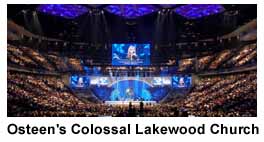 Houston, Texas. Osteen claims the nation’s largest congregation with over 30,000 members. Lakewood recently purchased the colossal Compaq Center, formerly home of the NBA’s Houston Rockets. After a whopping $95 million in renovations, the Compaq Center now houses Osteen’s empire called Lakewood Church.
Osteen continually sells out huge arenas (at $10 a ticket) across the country (on eBay,Osteen’s tickets list for over $100! Can you say ‘ch-ching?’)
New York Times (July 18, 2005) reports Lakewood’s 2004 revenues of $55 million. Osteen’s book of human-potential, self-esteem, “feel good,” self-help-guide titled, Your Best Life Now: Seven Steps to Living at Your Full Potential, ranks number one on the prestigious “New York Times” best-seller list. Wxyz.com writes of Osteen’s enormous popularity, “In the world of religion, he’s achieved the status of a rock star. . .”
Clearly, Mr. Osteen wears the coveted crown prince of the Christian kingdom. Osteen’s message is described as “. . . simple self-help message that congregants say is both uplifting and accessible. . .” Osteen proudly wears the title of “the smiling preacher.” His theology has been described as “cotton candy” theology, “tastes good” but no substance. Before we examine Osteen’s disturbing theology, let us lay some ground work for our critique.
Today’s Christians have been spiritually malnourished with a steady and unrelenting diet of “judge not, that ye be not judged. . .,” tolerant, inclusive “junk food” doctrine until they are completely void of any spiritual discernment. May I remind you in Matthew 7 where the popular “judge not, that ye be not judged. . .” mantra occurs contains the harshest warning in the Bible exposing false prophets and exercising personal spiritual discernment.
 The Lord Jesus in Matthew 7:21-23 provides the most enlightening and frightening warning found in all the scriptures. Many (not a few) people that openly call Jesus “Lord, Lord. . .” and many that “prophesy in thy name. . .” and “. . . cast out devils. . .” and in the name of Jesus Christ perform “many wonderful (not hateful, but nice, sweet) works. Jesus will utter “I NEVER knew you.” They were never saved. If they were ever saved. Jesus could not say, I NEVER knew you. Despite their “many wonderful works” in the name of Jesus, despite calling Him “Lord, Lord,” Jesus Christ will cast them into an eternal lake of fire, calling them “ye that work iniquity.”
Matthew 7:13-23
13 Enter ye in at the strait gate: for wide is the gate, and broad is the way, that leadeth to destruction, and many there be which go in thereat:
14 Because strait is the gate, and narrow is the way, which leadeth unto life, and few there be that find it.
15 Beware of false prophets, which come to you in sheep’s clothing, but inwardly they are ravening wolves.
16 Ye shall know them by their fruits. Do men gather grapes of thorns, or figs of thistles’
17 Even so every good tree bringeth forth good fruit; but a corrupt tree bringeth forth evil fruit.
18 A good tree cannot bring forth evil fruit, neither can a corrupt tree bring forth good fruit.
19 Every tree that bringeth not forth good fruit is hewn down, and cast into the fire.
20 Wherefore by their fruits ye shall know them.
21 Not every one that saith unto me, Lord, Lord, shall enter into the kingdom of heaven; but he that doeth the will of my Father which is in heaven.
22 Many will say to me in that day, Lord, Lord, have we not prophesied in thy name’ and in thy name have cast out devils’ and in thy name done many wonderful works’
23 And then will I profess unto them, I never knew you: depart from me, ye that work iniquity.
Matthew 7 (and there are many other scriptures) is an earth-shattering wake-up call for prayerful Bible discernment. If we, as Christians do not shine the exposing light of the Word of God upon preachers, Christians or anyone and everyone, how can we possibly obey the clear admonition of our Lord and Saviour in Matthew 7:15? How can we “Beware of false prophets, which come to you in sheep’s clothing, but inwardly they are ravening wolves”? If we do not “judge” who are the “false prophets”? How in the world can we even KNOW who are these “false prophets”? They appear as “sheep” or saved people, but they are “ravening wolves.” There is only one way; the unchangeable, perfect Word of God. There is a very serious and very deadly Christian belief perverting Christians that says, “I can’t judge them, I don’t know their heart.” The Lord Jesus Christ says in Matthew 15:19, “But those things which proceed out of the mouth come forth from the heart; and they defile the man.” What comes out the mouth is in the heart.
And what came out of the heart and mouth of Joel Osteen during the June 20, 2005 interview with Larry King literally sent shivers down my spiritual spine. As a Bible Believing researcher, I have researched many topics, many cultural issues and many false prophets, but what I heard repeatedly from the mouth of Joel Osteen on Larry King clearly ranks as the most disturbing words publicly coming out of a mainstream, accepted preacher. Bar none!
Before we view Osteen’s troubling statements, let me also add: we are not frivolously “sowing discord among brethren. . .” (Proverbs 6:19); we are not blindly, “. . . straining at a gnat, and swallowing a camel.” (Matthew 23:14); nor is any personal malice or contempt against Mr. Osteen intended.
As Bible Believers, we can disagree on certain doctrinal issues, but never the redemptive work and person of the Lord Jesus Christ. God forbid! God help us to never cease from exposing serious doctrinal errors, and make no mistake about it, several of Joel Osteen’s statements on Larry King Live were serious. Very serious. . .
The first very alarming portrait of Osteen’s heart (Matthew 12:34) deals with the most important subject in the Bible. Salvation is only through the redemptive blood of the Lord Jesus Christ at Calvary. Nothing is more important. Nothing is more evident in the scriptures. The following scriptures (among many) loudly and boldly proclaim Jesus Christ as the ONE and ONLY way of salvation, without any room for misinterpretation or misunderstanding. The Bible makes this crystal-clear. Other doctrines may have opportunity for argument, but not this one.
John 14:6
Jesus saith unto him, I am the way, the truth, and the life: no man cometh unto the Father, but by me.
Acts 4:12
Neither is there salvation in any other: for there is none other name under heaven given among men, whereby we must be saved.
John 3:36
He that believeth on the Son hath everlasting life: and he that believeth not the Son shall not see life; but the wrath of God abideth on him.
1 Timothy 2:5-6
For there is one God, and one mediator between God and men, the man Christ Jesus;
Who gave himself a ransom for all, to be testified in due time.

On Larry King Live, the following very disturbing conversation occurred with Larry King and Joel Osteen:
KING: What if you’re Jewish or Muslim, you don’t accept Christ at all?
OSTEEN: You know, I’m very careful about saying who would and wouldn’t go to heaven. I don’t know …
At this point, even Larry King appears surprised by Osteen’s answer. Then Larry tosses Osteen a “soft-ball” to explain his previous answer. And again Osteen openly denies that Jesus Christ is the ONLY way of salvation.
KING: If you believe you have to believe in Christ’ They’re wrong, aren’t they?
OSTEEN: Well, I don’t know if I believe they’re wrong. I believe here’s what the Bible teaches and from the Christian faith this is what I believe. But I just think that only God will judge a person’s heart. I spent a lot of time in India with my father. I don’t know all about their religion. But I know they love God. And I don’t know. I’ve seen their sincerity. So I don’t know. I know for me, and what the Bible teaches, I want to have a relationship with Jesus.
Again Osteen denies the redemptive work of the Lord Jesus Christ. Notice, he praises the pagan, false-religion of India as “I know they love God.” Unbelievable. . .
I’m sure some reading this are thinking, “Well, maybe Larry caught Joel Osteen flat footed. Maybe Osteen wasn’t prepared. If Osteen only had been given another chance to testify of the redemptive work of the Lord Jesus Christ, he’d get it straightened out.
Osteen did get another chance. . .
After Larry King opened the phone lines, a concerned Christian asks Joel to clarify his previous statement (which we just viewed). Again Osteen could easily clear this up.
CALLER: Hello, Larry. You’re the best, and thank you, Joe — Joel — for your positive messages and your book. I’m wondering, though, why you side-stepped Larry’s earlier question about how we get to heaven? The Bible clearly tells us that Jesus is the way, the truth and the light and the only way to the father is through him. That’s not really a message of condemnation but of truth.
OSTEEN: Yes, I would agree with her. I believe that. . .
KING: So then a Jew is not going to heaven?
OSTEEN: No. Here’s my thing, Larry, is I can’t judge somebody’s heart. You know, only God can look at somebody’s heart, and so — I don’t know. To me, it’s not my business to say, you know, this one is or this one isn’t. I just say, here’s what the Bible teaches and I’m going to put my faith in Christ. And I just I think it’s wrong when you go around saying, you’re saying you’re not going, you’re not going, you’re not going, because it’s not exactly my way. I’m just…
KING: But you believe your way.
OSTEEN: I believe my way. I believe my way with all my heart.
KING: But for someone who doesn’t share it is wrong, isn’t he?
OSTEEN: Well, yes. Well, I don’t know if I look at it like that. I would present my way, but I’m just going to let God be the judge of that. I don’t know. I don’t know.
KING: So you make no judgment on anyone?
OSTEEN: No. But I…
And here Larry really tosses Joel a soft-ball. How about a God-defying atheist? And again, Osteen will not confess that Jesus Christ is the ONLY way of salvation.
KING: What about atheists?
OSTEEN: You know what, I’m going to let someone — I’m going to let God be the judge of who goes to heaven and hell. I just — again, I present the truth, and I say it every week. You know, I believe it’s a relationship with Jesus. But you know what? I’m not going to go around telling everybody else if they don’t want to believe that that’s going to be their choice. God’s got to look at your own heart. God’s got to look at your heart, and only God knows that.
Friend, the Bible is clear. There is one, and only one way out of an eternal hell and that is the blood of the Lord Jesus  Christ. Not simply “a relationship with Jesus Christ.” Judas Iscariot had a “relationship” with Jesus Christ, walking and talking with the Lord, and even “kissing” the Lord (Luke 22:47), but Judas went to hell (Acts 1:25). Revelation 2:15 reads, “And from Jesus Christ, who is the faithful witness, and the first begotten of the dead, and the prince of the kings of the earth. Unto him that loved us, and washed us from our sins in his own blood,”
What can wash away my sins? NOTHING BUT THE BLOOD OF JESUS!
The teaching professed by Osteen that “. . . God’s got to look at your heart. . .” for salvation is wrong. It is grossly wrong. It is deadly wrong. God has already “looked at you heart.” In Jeremiah 17:9, the Lord says, “The heart is deceitful above all things, and desperately wicked: who can know it?” Proverbs 28:26, says, “He that trusteth in his own heart is a fool. . .” The Lord Jesus says, in Matthew 15 “But those things which proceed out of the mouth come forth from the heart; and they defile the man. For out of the heart proceed evil thoughts, murders, adulteries, fornications, thefts, false witness, blasphemies:”
Osteen’s refusal to confess the sole redemptive salvation of the Lord Jesus Christ sent shock waves among many of Osteen’s followers. Because of the amount of email and letters questioning his statements, Osteen issued an apology on his web site, stating:
| Dear Friend,Many of you have called, written or e-mailed regarding my recent appearance on Larry King Live. I appreciate your comments and value your words of correction and encouragement. It was never my desire or intention to leave any doubt as to what I believe and Whom I serve. I believe with all my heart that it is only through Christ that we have hope in eternal life. I regret and sincerely apologize that I was unclear on the very thing in which I have dedicated my life.Jesus declared in John 14; I am the way, the truth and the life. No one comes to the Father but by me. I believe that Jesus Christ alone is the only way to salvation. However, it wasn’t until I had the opportunity to review the transcript of the interview that I realize I had not clearly stated that having a personal relationship with Jesus is the only way to heaven. It’s about the individual’s choice to follow Him.God has given me a platform to present the Gospel to a very diverse audience. In my desire not to alienate the people that Jesus came to save, I did not clearly communicate the convictions that I hold so precious.I will use this as a learning experience and believe that God will ultimately use it for my good and His glory. I am comforted by the fact that He sees my heart and knows my intentions. I am so thankful that I have friends, like you, who are willing to share their concerns with me.
Thank you again to those who have written. I hope that you accept my deepest apology and see it in your heart to extend to me grace and forgiveness. As always, I covet your prayers and I am believing for God’s best in your life, (http://www.joelosteen.com/site/PageServer’pagename=LarryKingLetter) |
I find it ironic and demeaning that Osteen said he “was unclear on the very thing in which I have dedicated my life.” He was not UNCLEAR. He was crystal clear. He consistently and clearly rejected that the Lord Jesus Christ was the ONLY way of salvation! We’re not talking about a “babe in Christ.” We are talking about the pastor of the largest church in the nation! Here he is as an ambassador for the Lord Jesus on a very popular television show and refuses to acknowledge the very thing he supposedly has “dedicated his life”? Something’s seriously wrong with this picture!
Osteen’s glossing, or apologizing for his serious statements, does not negate his repeatedly refusal to confess that Jesus Christ is the only way of salvation. If his answers were not so clear, nor given several chances to clarify, his apology might be appropriate. But the heart and soul of the Christian faith is the sole redemptive blood of the Lord Jesus. Without that, there exists no Christian faith. For a preacher to repeatedly refuse to confess that Jesus Christ as the only way of salvation is without excuse, nor apology.
1 Peter 3:15 admonishes the Christian: “But sanctify the Lord God in your hearts: and be ready always to give an answer to every man that asketh you a reason of the hope that is in you with meekness and fear:”
Many other statements from Osteen during the Larry King interview were blatantly in opposition to the Word of God.
KING: But you’re not fire and brimstone, right? You’re not pound the decks and hell and damnation?
OSTEEN: No. That’s not me. It’s never been me. I’ve always been an encourager at heart. And when I took over from my father he came from the Southern Baptist background and back 40, 50 years ago there was a lot more of that. But, you know, I just — I don’t believe in that. I don’t believe — maybe it was for a time. But I don’t have it in my heart to condemn people. I’m there to encourage them. I see myself more as a coach, as a motivator to help them experience the life God has for us.
Friend, the greatest “fire and brimstone” preacher that ever lived was the Lord Jesus! He preached about hell more than any other subject. If you don’t believe in proclaiming fire and brimstone, as Osteen openly confesses, you do not believe the Bible! It’s that simple.
Jesus Christ took hell very serious. In Mark 9:43-47 the Lord says,
43 And if thy hand offend thee, cut it off: it is better for thee to enter into life maimed, than having two hands to go into hell, into the fire that never shall be quenched:
45 And if thy foot offend thee, cut it off: it is better for thee to enter halt into life, than having two feet to be cast into hell, into the fire that never shall be quenched:
47 And if thine eye offend thee, pluck it out: it is better for thee to enter into the kingdom of God with one eye, than having two eyes to be cast into hell fire:
Jesus Christ took hell so serious, he could say without the slightest hesitation to remove your eye, cut off your hand or foot, if that would keep you out of hell!
If hell is not real, Jesus Christ was the most deceived man that ever lived!
Osteen may sound pious and sweet to say, “. . . I don’t have it in my heart to condemn people,” but according to the Lord Jesus, they are already condemned. The Lord says in John 3:18, “He that believeth on him is not condemned: but he that believeth not is condemned already, because he hath not believed in the name of the only begotten Son of God.”
The Christian’s message is not condemnation, but the way out of ALREADY condemnation. If there is no “hell fire and brimstone,” there is no reason for Jesus dying on the cross. It was a waste. Hell is as much a part of the gospel, as the blood of Jesus Christ. No hell. No blood. No heaven. No gospel. . .
Friend, if we believe the Bible it is our duty and decency to warn people about hell! Warning someone of the fires of eternal hell is not condemning them – it is just the opposite – we are trying to keep them from being condemned in hell!
Because of Osteen’s vague and confusing answers, Larry King point-blank asks Osteen if he believed the Bible. (What a strange question to ask the pastor of the largest church in America)
KING: You believe in the Bible literally?
OSTEEN: I do, I do.
There is a problem here – a very, very serious problem. Here is a man that claims to believe the Bible literally. And the Bible over and over and over, warns of a place of called hell, a place of eternal fire and torments where the majority of people will suffer in torments for all eternity.
Matthew 13:49-50
49 So shall it be at the end of the world: the angels shall come forth, and sever the wicked from among the just,
50 And shall cast them into the furnace of fire: there shall be wailing and gnashing of teeth. Revelation 14:10-11
10 The same shall drink of the wine of the wrath of God, which is poured out without mixture into the cup of his indignation; and he shall be tormented with fire and brimstone in the presence of the holy angels, and in the presence of the Lamb:
11 And the smoke of their torment ascendeth up for ever and ever: and they have no rest day nor night,
Revelation 20:15
And whosoever was not found written in the book of life was cast into the lake of fire.
How can Mr. Osteen, or anyone, claim to believe the Bible and deliberately refuse to warn people about hell? Is anyone that mean or hateful or so depraved that they willingly refuse to warn others? I’m reminded of a gut-wrenching illustration in Why Revival Tarries, by Leonard Ravenhill:
Charlie Peace was a criminal. Laws of God or man curbed him not. Finally the law caught up with him, and he was condemned to death. On the fatal morning in Armley Jail, Leeds, England, he was taken on the death-walk. Before him went the prison chaplain, routinely and sleepily reading some Bible verses. The criminal touched the preacher and asked what he was reading. “The Consolations of Religion,” was the replay. Charlie Peace was shocked at the way he professionally read about hell.
Could a man be so unmoved under the very shadow of the scaffold as to lead a fellow-human there and yet, dry-eyed, read of a pit that has no bottom into which this fellow must fall? Could this preacher believe the words that there is an eternal fire that never consumes its victims, and yet slide over the phrase with a tremor? Is a man human at all who can say with no tears, “You will be eternally dying and yet never know the relief that death brings?”
All this was too much for Charlie Peace. So he preached. Listen to his on-the-eve-of-hell sermon. “Sir” addressing the preacher, “if I believed what you and the church of God say that you believe, even if England were covered with broken glass from coast to coast, I would walk over it, if need be, on hands and knees and think it worth while living, just to save one soul from an eternal hell like that!” (Ravenhill, Leonard, Why Revival Tarries, Fires of Revival Publishers, Zachary, LA, 1973, p. 19)
Is it possible that a man could be so cruel and so criminal to actually believe in hell and steadfastly refuse to warn fellow human beings?
Recently, a local TV station interviewed a man that rescued a sleeping family from a burning house. He was riding by the house, saw the raging fire and at the danger of his own life, ran inside the flaming house, screaming and yelling for the family to wake up and get out! The newscaster asked him, “How does it feel to be a hero?” His reply was simply, “I’m no hero; I just did what any decent human being would have done.”
Hear me and hear me well – a man that professes to believe the Bible and refuses to warn people about hell; either does not really believe that Bible, or they are the worse criminal and villain on this earth! And I don’t care how big a church they have, or how nice, sweet, loving, compassionate or pious they may sound – they are a wicked devil in disguise!
Will you go and speak to the sinners blind
And who walk in the midnight gloom’
Will you bear some light to their darkened mind’
Will you tell them their coming doom’
Will you seek them now, Will you seek them now’
Will you show them the way’ Will you show them the way’
Some one may be lost, That you might lead home, To that bright land of perfect day.
– Seeking the Lost, A. J. Bu苞han苔n, 1889
In the interview, Larry King tossed Osteen another “soft-ball,” asking Osteen about the wicked and vile sins of abortion and homosexuality. Even lost people take a stand on these blatant “sins.”
KING: How about issues that the church has feelings about’ Abortion’ Same-sex marriages’
OSTEEN: Yeah. You know what, Larry? I don’t go there. I just …
KING: You have thoughts, though.
OSTEEN: I have thoughts. I just, you know, I don’t think that a same-sex marriage is the way God intended it to be. I don’t think abortion is the best. I think there are other, you know, a better way to live your life. But I’m not going to condemn those people. I tell them all the time our church is open for everybody.
Again, Larry appears surprised at Osteen’s waffling. Larry allows Osteen to clarify his confusing position. And again Osteen blatantly contradicts the words of the Lord Jesus Christ.
KING: You don’t call them sinners?
OSTEEN: I don’t.
KING: Is that a word you don’t use?
OSTEEN: I don’t use it. I never thought about it. But I probably don’t. But most people already know what they’re doing wrong. When I get them to church I want to tell them that you can change. There can be a difference in your life. So I don’t go down the road of condemning.
The word “sin” occurs in the King James Bible over 830 times!
After the previous surprising answers, Larry then asks Osteen the obvious question: Do you believe the Bible?
KING: You believe in the Bible literally?
OSTEEN: I do, I do.
The following conversation during King’s interview displays how far Osteen and the Bible differ.
KING: Is it hard to lead a Christian life?
OSTEEN: I don’t think it’s that hard. To me it’s fun. We have joy and happiness. Our family — I don’t feel like that at all. I’m not trying to follow a set of rules and stuff. I’m just living my life.
KING: But you have rules, don’t you?
OSTEEN: We do have rules. But the main rule to me is to honor God with your life. To live a life of integrity. Not be selfish. You know, help others. But that’s really the essence of the Christian faith.
The “essence of Osteen’s Christian faith” is to “help others.” (And along the way make a few million dollars.)
In 1 Corinthians 15:3-4, the apostle Paul gives us the “essence” of the Christian faith:
1 Corinthians 15:3-4
3 For I delivered unto you first of all that which I also received, how that Christ died for our sins according to the scriptures;
4 And that he was buried, and that he rose again the third day according to the scriptures:
Stay away from Joel Osteen and his no condemnation, self-esteem, false-gospel. Warn others. Stay away! There is too much at stake, your eternal soul.
Have you been saved?
It’s simple to be saved …
- Realize you are a sinner.
“As it is written, There is none righteous, no, not one:” Romans 3:10
“… for there is no difference. For all have sinned, and come short of the glory of God;” Romans 3:23
- Realize you CAN NOT save yourself.
“But we are all as an unclean thing, and all our righteousnesses are as filthy rags; …” Isaiah 64:6
“Not by works of righteousness which we have done, but according to his mercy he saved us, …” Titus 3:5
- Realize that Jesus Christ died on the cross to pay for your sins.
“Who his own self bare our sins in his own body on the tree, …” 1 Peter 2:24
“… Unto him that loved us, and washed us from our sins in his own blood,” Revelation 1:5
- Simply by faith receive Jesus Christ as your personal Savior.
“But as many as received him, to them gave he power to become the sons of God, even to them that believe on his name:” John 1:12
” …Sirs, what must I do to be saved’ And they said, Believe on the Lord Jesus Christ, and thou shalt be saved, and thy house.”” Acts 16:30,31
“For God so loved the world, that he gave his only begotten Son, that whosoever believeth in him should not perish, but have everlasting life.” John 3:16
WOULD YOU LIKE TO BE SAVED?’
Pray this prayer, and mean it with all your heart.
Lord Jesus, I know that I am a sinner, and unless you save me I am lost forever. I thank you for dying for me at Calvary. I come to you now, Lord the best way I know how, and ask you to save me. I now receive you as my Savior. In Jesus Christ Name, Amen.
“How shall we escape, if we neglect so great salvation;”
Hebrews 2:3
[Article Reprinted with Permission]